
Disclaimer: I am not a security researcher or a cybersecurity expert. I am sharing my stance based on my understanding and limited research on the topic.
I remembered in my project obs-service-cargo that there were some opened issues #64 and #72. These two issues told that the project does not produce idempotent or deterministic build outputs yet it passed audits.
Honestly, at that time, I don't know much about reproducible builds but I do know that it is an attempt to build a project from different builder sources and hopefully, it matches the checksum of their build outputs.
PR #78 actually "fixed" the bug. But I still have doubts. And after learning it from William Brown, aka, firstyear, from his blog and from Taviso's blog, I realised that reproducible builds does not take account the social engineering in risk modelling when it comes to human behaviour.
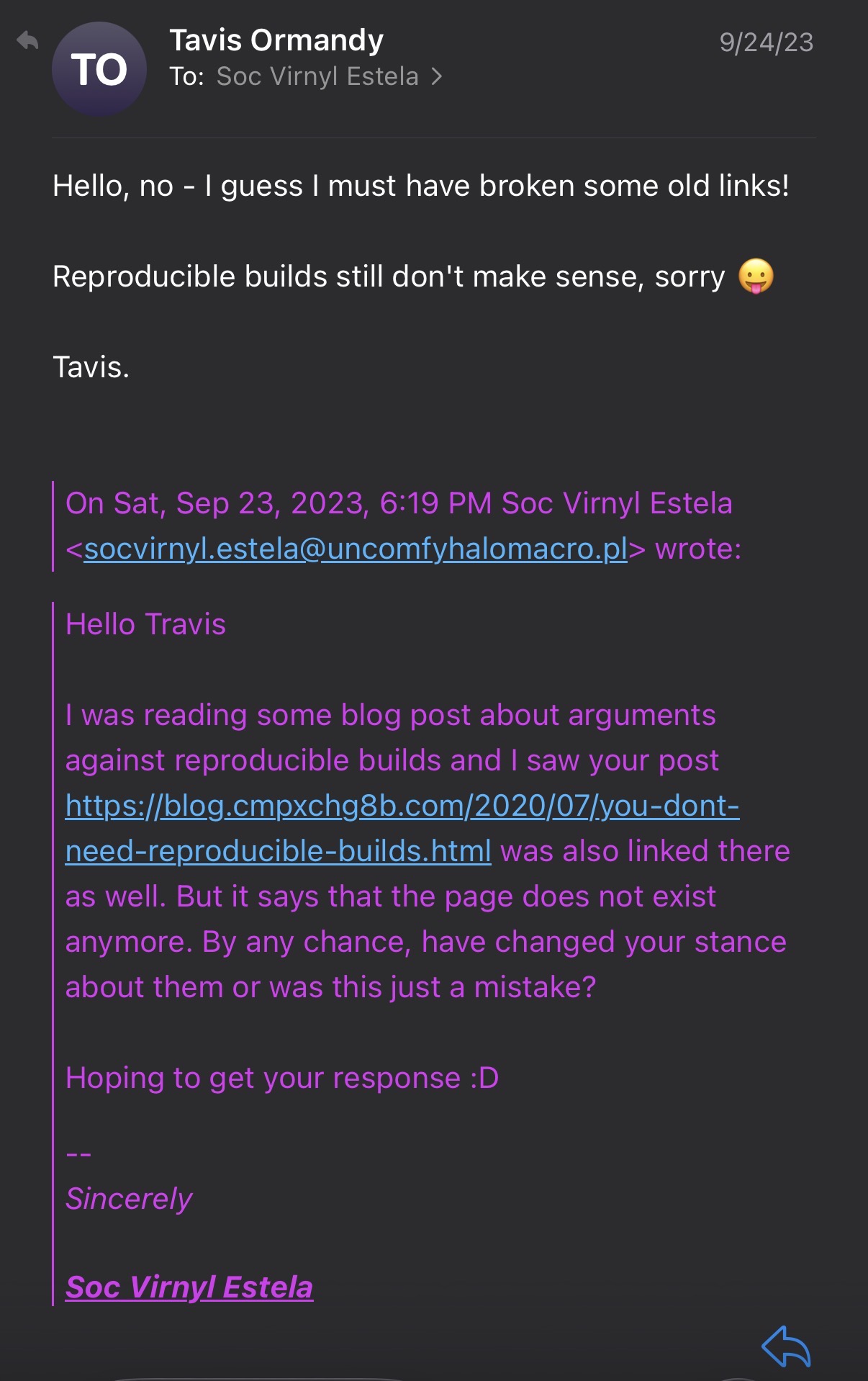
You might wonder if Taviso has changed his stance since it is on web archive (or wayback machine) now but I did email him and he replied that he didn't change his stance on the matter.
Yes, this post was overdue and was supposed to be written 3 years ago but I can't sleep and I am bored so while I still have this in mind, why not write a new post?
An example of an upstream and downstream build§
This might not be the best excalidraw + mermaid diagram but I hope it shows an overview of how a downstream and upstream builds their own sources. Let's call this project, Project UWU.
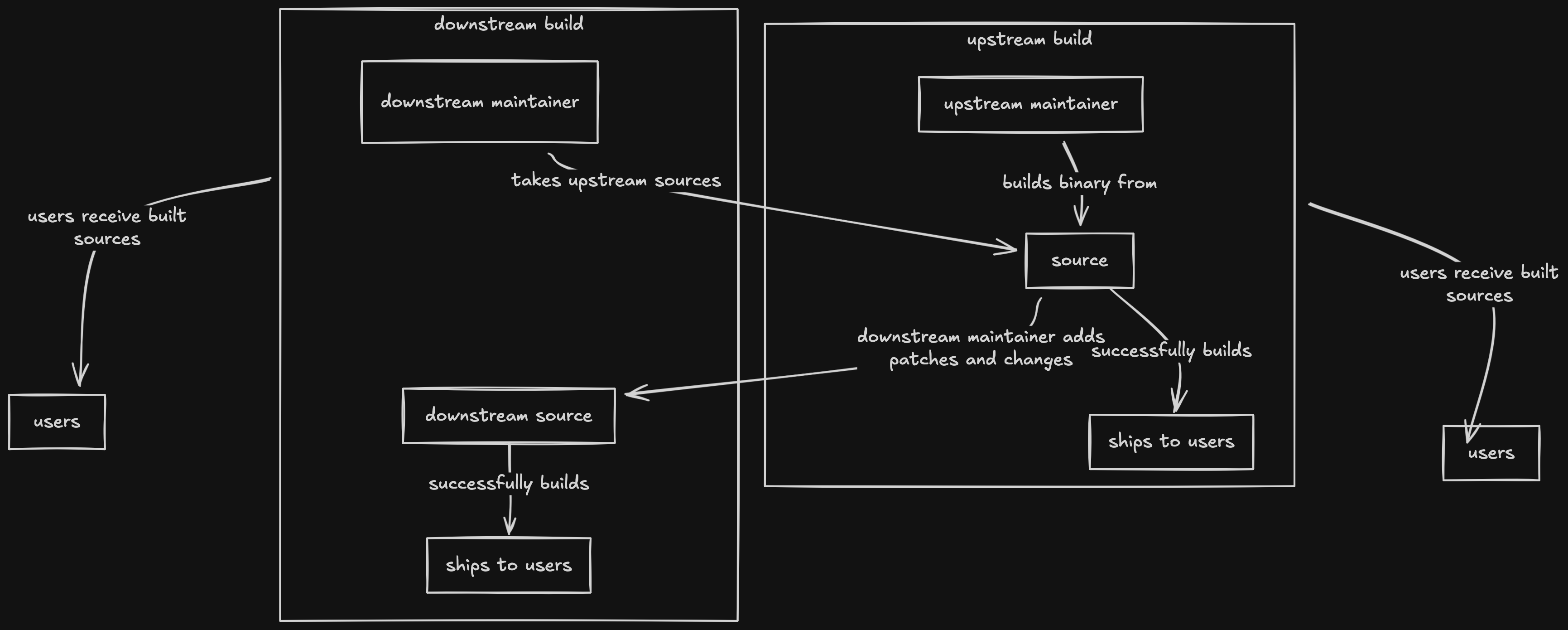
As you can see here, if we take this literally like how the flowchart looks like, under no circumstances that sources and built sources from both upstream and downstream contains any malicious intent (well... there is no mention of it yet). But that's from an ideal world, and we are living in one where there are also evil people (I am one of them 😈).
Joking aside, let's assume that the sources from upstream built the same checksum following reproducible build principles.
source has checksum 'abcd'
built source has checksum 'uwuwu'
Of course, the downstream one has a different checksum for its built sources than the upstream one. But both will have the checksum for the unbuilt sources themselves, usually a tarball or zip archive.
source has checksum 'abcd'
built source after patches has checksum 'notuwuenough'
The benefit of this is that if let's say a distribution have to rebuilt its sources since other packages have updated but the underlying compiler tool necessary to build Project UWU still has unchanged version and is the same across all updated machines. Therefore, we can skip building the downstream variant of Project UWU.
Do not ever forget the evil people§
Remember what I said about social engineering and evil people? Yes, they exist. What can you even do about them? Nothing. They can do whatever the hell they want.
The keyword we should talk about here is Trust, (not the Filipino brand).
Let's update our flowchart again so you can see what I mean.
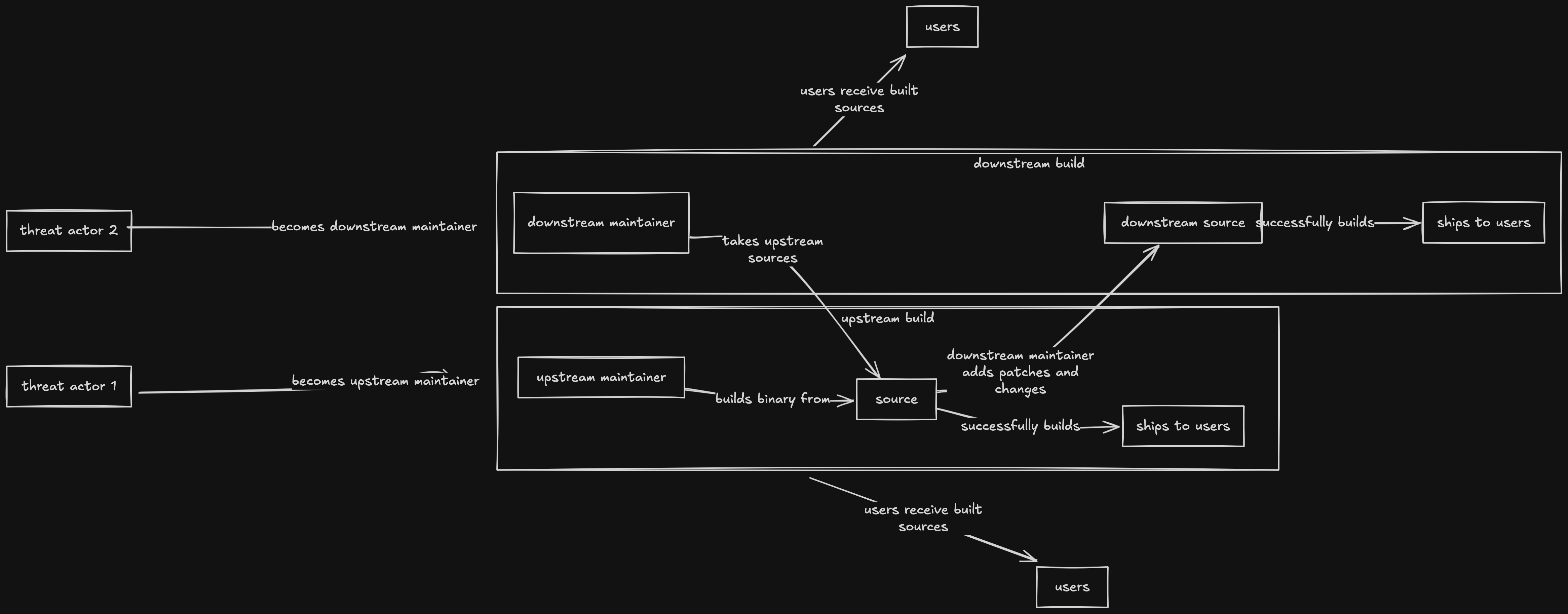
As you can see from the flowchart above (please zoom or open it in a new tab huhu), IT ONLY TAKES 1 CHANGE OF MAINTAINER FOR UPSTREAM TO ACTUALLY BECOME A THREAT. The same thing could be said to the downstream maintainer.
In the case of the upstream, this would affect the whole supply chain since
- Downstream relies on it
- It's the only thing that exists
- Because there is no other person or persons to maintain this so YOLO?
In the case of the downstream, this would affect the partial (and sometimes whole) supply chain since
- They can provide "innocent" patches to both downstream and upstream
- Consumers are using it on the downstream distribution because they trust the downstream maintainer
Yeah, Project UWU can un-cute itself because of evil people 😝
So how can reproducible builds not protect us§
What I can see from here is that reproducible builds cannot protect us from these kinds of threats because
- It only takes 1 evil person to fuck up the supply chain
- Trusting is hard and in this kind of scenario, your only option is to trust that the maintainer/contributor is not a psychopath.
- The checksums do not matter when you are already compromised. However, you can keep a record of the checksum of a malicious source.
The only way reproducible builds can mitigate threats, from what I can understand, is after the threats has happened. But it does not protect us from any present event a compromised source/build has happened until it is noticed.
But what about being reproducible?§
Well, it does help with build times, but eh... that's the only benefit it can give—to save energy and compute.
Conclusion§
I know I know I am repeating words, I haven't even looked at the blog posts just to see if I can remember what I understand about why reproducible builds cannot protect us from present threats. I am not a cybersecurity expert either. But I have a big imagination.
The only benefit I can imagine from reproducible builds is a record of checksums of malicious sources as well as the record of checksums of malicious built sources.
But it is a fact that many are passionate in building infrastructure around it just to prove that it works. However, it still fails to address the social engineering which is a big factor in security.
Anyway, goodnight. I think it's 2AM now around my timezone. I need to fix my sleep schedule.